
How Do You Market Wedding Journalism?
The crisis of building a brand in a vendor category that doesn’t exist yet
There's a moment in every conversation I have with a new vendor or a potential client where I watch their face shift. I say “wedding journalism,” and they tilt their head slightly with a look somewhere in between confusion and curiosity.
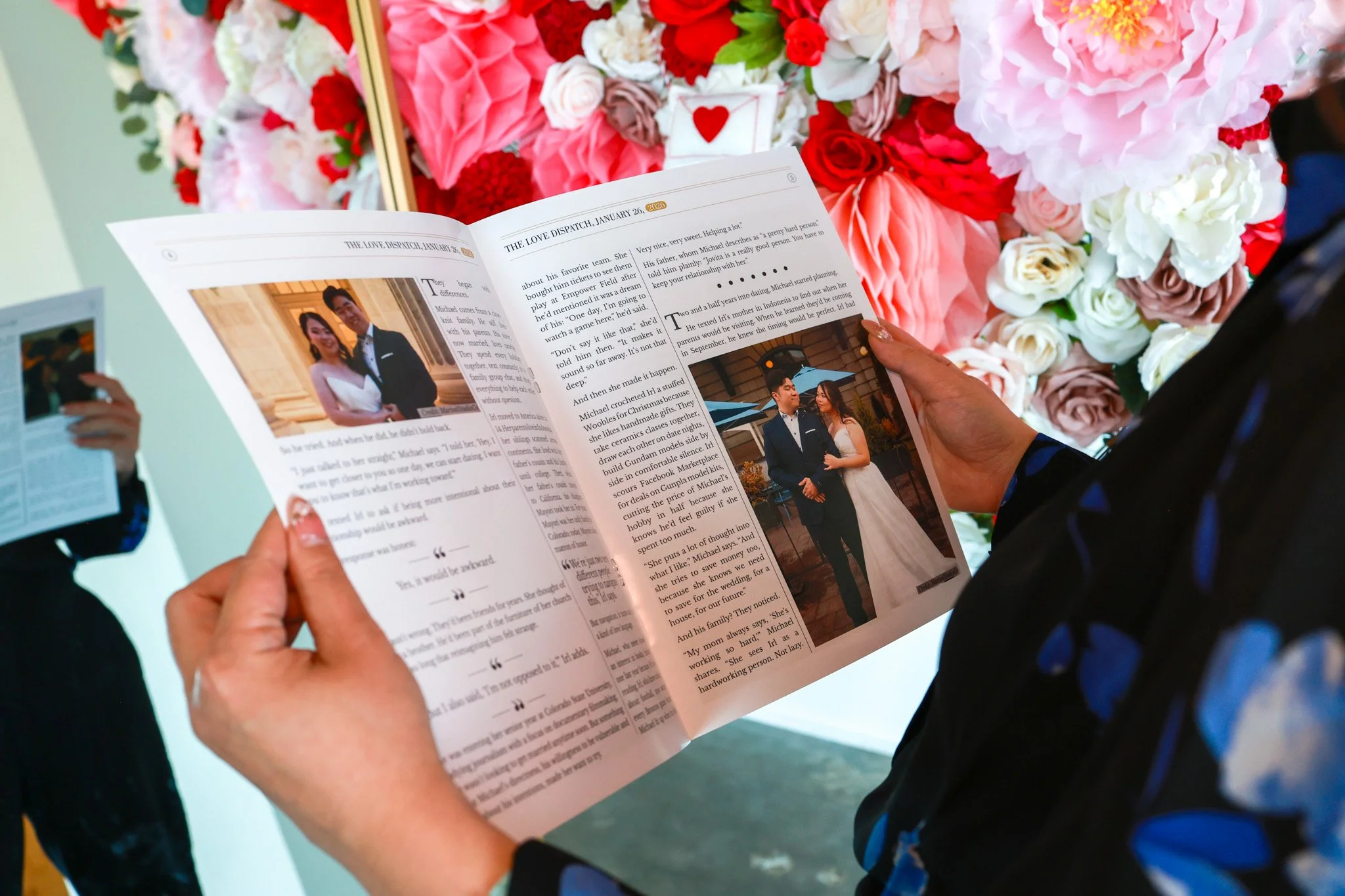
Then I explain it. I’m a journalist. I interview couples, their families, their guests, their wedding parties. I write their stories into custom printed magazines. The whole thing is crafted by hand. And almost every time, the same thing happens: the head tilt turns into a nod, and the nod turns into something warmer. Oh, that's beautiful. I didn’t know that existed.
That second sentence sums up the whole problem facing my business currently.
The search volume problem
When a couple in Denver sits down to plan their wedding, they Google “wedding photographer Denver.” They Google “wedding planner Colorado.” They Google “DJ,” “florist,” “caterer,” “venue.” These are known categories with established search volume, existing expectations, and years of SEO infrastructure behind them.
Nobody is Googling “Colorado wedding journalist.” And if they Google “wedding journalism,” what comes up is wedding photographers who describe their shooting style as photojournalistic. The search term I’d most naturally claim is already occupied by a different profession describing a different service. I’m not competing for a keyword with other wedding journalists. I’m competing for it with photographers who use the word “journalistic” as an aesthetic descriptor. (see below)
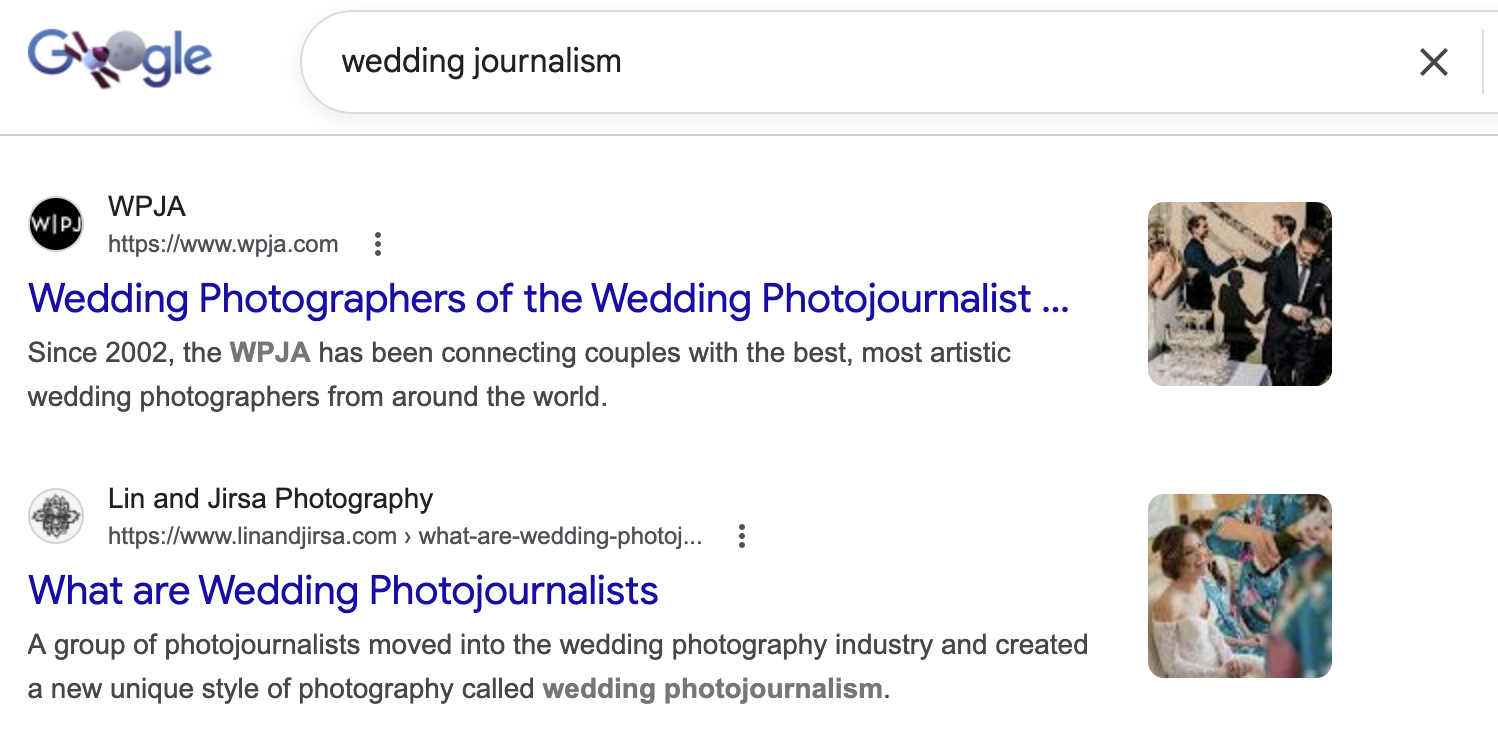
This is the central marketing challenge of building a business in a category that hasn’t been named yet. The standard playbook assumes you're competing for an existing audience. It assumes people know what they want and are searching for it. Your job, the playbook says, is to show up when they search and convince them to choose you over the competition.
But what if the search itself doesn’t lead to you? What if the work isn't convincing someone to choose you, but teaching them that what you offer is a thing that exists at all?
Education before conversion
Every prospect conversation I have starts with teaching. Not selling. Teaching.
I’ve found this at every event I've attended so far, whether it was the 5280 Event Society’s Unbridal Show, where I was scoping the space as both a bride and a new vendor, or the Bridal and Wedding Expo, where I exhibited for the first time. People don’t arrive already knowing what wedding journalism is. They stop because something catches their eye — maybe my sign, or my magazines — or because I say something that makes them pause. And then I have about ninety seconds to explain the concept before their attention moves on.
That’s the math of marketing a new category. You're spending your conversion window on education. By the time the person understands what you’re offering, the time you'd normally use to close is already spent.
And here's what's been both encouraging and frustrating: once people understand the concept, they rarely need convincing. The value clicks almost immediately. The reaction isn't “why would I want that?” It’s “why hasn’t anyone done this before?” Everyone seems to understand, almost instinctively, that having your love story captured in words is something worth holding onto.
The product isn’t the hard sell. The category is.
Where does the money go?
The education problem creates a spending problem. And with a small marketing budget, every dollar that doesn’t move the needle goes into a black hole.
I know where my leads come from. That’s not the issue. The issue is that the channels I’ve spent actual money on haven’t been the ones producing them.
I pay for a listing on The Knot. So far, it hasn’t generated a single inquiry. I’ve run paid ads on Instagram and TikTok. I’ve paid to exhibit at expos. I’ve posted in Colorado bride Facebook groups. These are the things that wedding industry advice tells you to do: get on the platforms where couples are already looking, put yourself in rooms full of engaged people, boost your content so the algorithm shows it to more eyes.
The problem is that all of those channels assume the couple already knows what they’re looking for. A The Knot listing works when someone types “photographer” into a search bar and browses results. It doesn’t work as well when the couple has never heard of wedding journalism. The Love Dispatch is currently categorized as a wedding favor, because none of the other vendor categories really describe my service accurately. But when people browse wedding favors, they’re not exactly imagining a wedding magazine.
The same tension shows up with paid social. I can boost a reel about wedding journalism, and the algorithm will show it to people who engage with wedding content. But engagement with a reel is not the same as understanding a new concept well enough to inquire about it. The scroll is too fast. The format is too short. By the time someone pauses long enough to think “wait, what is that?” — they’ve already swiped past.
So every month I'm looking at my expenses and asking myself: is The Knot listing worth it? (Probably not.) Do I run another round of ads that generate impressions but not inquiries? (Also a no.) Should I run a paid ad on Google? (I doubt anyone is searching for “wedding journalist.”) Do I sign up for another expo? (I am doing this, but with a smaller, more intimate show.) Or do I put that money toward gas and coffee and sample magazines and keep building relationships one at a time?
There’s no marketing playbook for someone creating a new category. The wedding industry marketing advice assumes you’re selling something people already want. When you’re selling something people don't know exists yet, the standard channels feel like pouring water into sand. It goes somewhere, sure… you just can’t see where.
What actually works (so far)
I’m a few months into this business, so I want to be honest about what I know and what I’m still figuring out. But some patterns are starting to emerge.
Relationships outperform content. The most meaningful progress I’ve made hasn’t come from Instagram reels or these blog posts. It’s come from conversations with real people. Couples who fell in love with my work at an expo. A vendor who met me at an expo and remembered what I do. A warm introduction from a colleague. In an industry built on referrals, the most effective marketing I’ve done has been showing up, being genuine, and trusting that the right people will remember me when the moment comes.
Physical samples close the gap faster than any copy I can write. I have completed magazines in my portfolio now, and when someone holds one, the explanation is over. They can see what this is. They can feel the weight of it. They can flip to a page and read a quote, see a photo spread in all its glory. The product explains itself better than I ever could.
What I’m betting on
I don’t have the marketing problem solved. I’m still in the middle of it. But I’ve made a bet, and I think it’s the right one.
I’m betting on relationships over reach. I’m betting that a handful of genuine partnerships with planners and venues will generate more bookings than a thousand impressions on Instagram ads. I’m betting that showing up to networking events and expos with a physical magazine in my hands will always be more persuasive than any digital ad. I’m betting that the couples who find me will find me through TikTok, or people they trust — not through Google or The Knot.
And I’m betting that writing about this process honestly, in posts like this one, will do something that a polished marketing funnel can't: it’ll show people who I am. A journalist who cares about doing this well. A business owner who’s figuring this all out in real time. Someone who believes that the stories inside a wedding are worth telling, and worth keeping, even if the world hasn’t learned to search for them yet.
The category will catch up. In the meantime, I’ll keep explaining wedding journalism, one head tilt at a time.
